

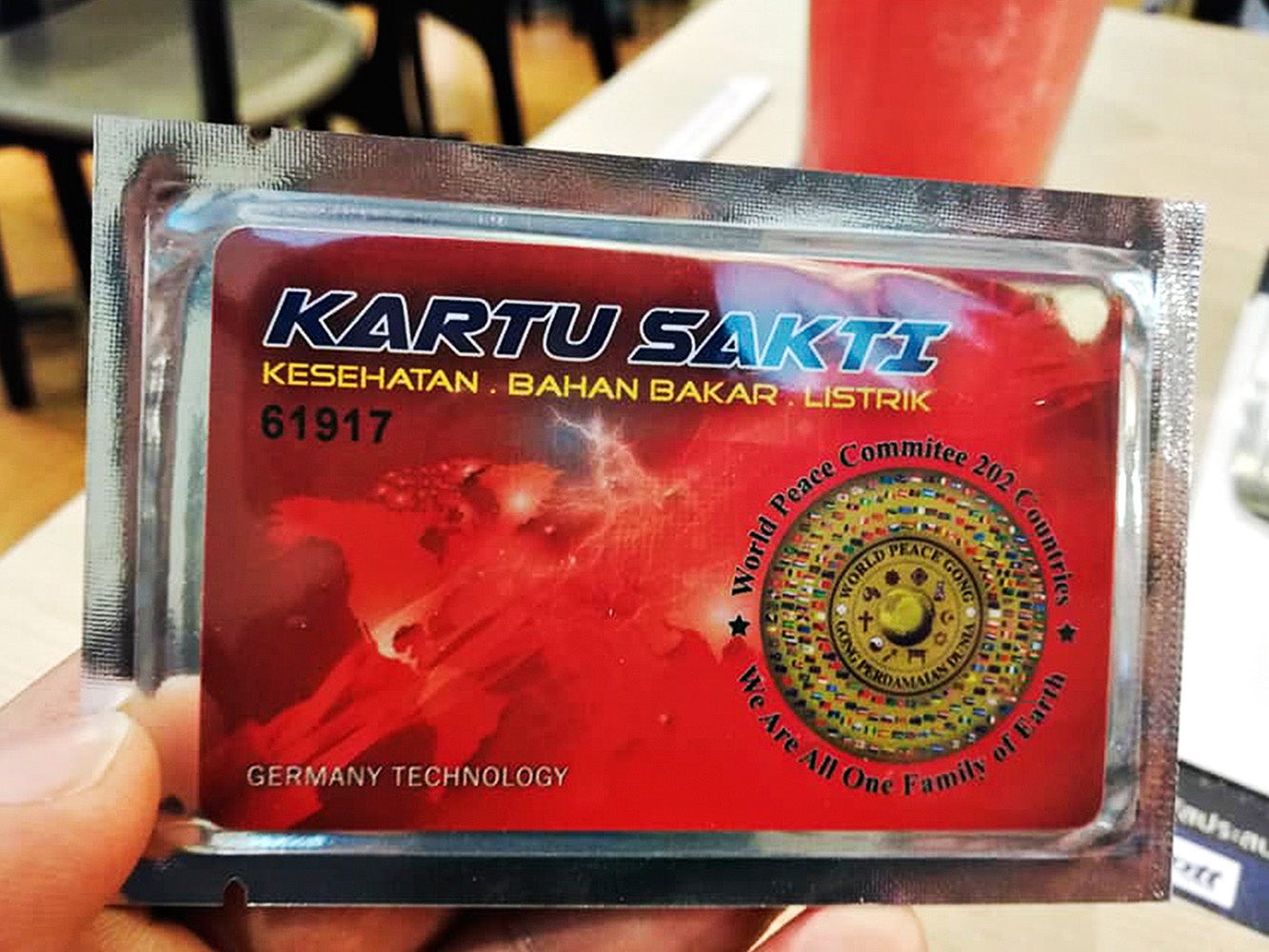

“Magic cards” being sold in Thailand as a cure-all for diseases have reportedly been found to emit dangerously high levels of radiation.
The bogus cards, allegedly produced by a company called Expert Pro Network, are being bought in the northeastern province of Khon Kaen for up to 1,500 baht (£38) by locals, who put the cards on different parts of their bodies and even dip them in drinking water, the Bangkok Post reported.
But according to the newspaper, the Office of Atoms for Peace (OAP), Thailand’s nuclear research department, found some of the plastic cards were emitting radiation up to 350 times the safe limit for humans.
Subsequent X-rays reportedly showed the cards had the radioactive elements uranium and thorium spread across their surface.
“We are currently trying to analyse the degree of radioactive contamination in the area,” the OAP were reported as saying in a statement.
1/25
Evening in the ghost town of Pripyat
John Levin
2/25
A gas mask hangs in a building inside the Chernobyl Exclusion Zone
Ryan Longstaff/SWNS
3/25
Remains of Soviet propaganda in one of the barracks of the abandoned anti-aircraft base Volkhov near the Chernobyl NPP
John Levin
4/25
The shell of a television stands inside a building in the Chernobyl exclusion zone
Ryan Longstaff/SWNS
5/25
A children’s play area inside the Chernobyl exclusion zone
Ryan Longstaff/SWNS
6/25
A Soviet-era classroom in the Chernobyl exclusion zone
Ryan Longstaff/SWNS
7/25
Tourists inside the Chernobyl exclusion zone
Ryan Longstaff/SWNS
8/25
Duga was a Soviet over-the-horizon (OTH) radar system used as part of the Soviet missile defense early-warning radar network
John Levin
9/25
In the Pripyat abandoned apartments you can still see the abandoned belongings of evacuated residents of the city
John Levin
10/25
“Ambulance car model RAF-2203 Latvija (nickname Rafik) on the background of the Medical Sanitary Unit 126 in Pripyat. It was a minibus designed and developed by Rīgas Autobusu Fabrika from 1976–1997. They were widely used throughout the USSR as medical cars. Model RAF-2203 also were used in Pripyat”
John Levin
11/25
Remains of Soviet propaganda in one of the barracks of the abandoned anti-aircraft base Volkhov near the Chernobyl NPP
Ryan Longstaff/SWNS
12/25
An empty swimming pool inside the Chernobyl exclusion zone
Ryan Longstaff/SWNS
13/25
“Illegal Chernobyl explorers cross the Uzh river in the Chernobyl Exclusion Zone. This is the time when you can safely walk around the abandoned without fear of being caught by the police”
John Levin
14/25
“A couple of years ago the Ukrainian army began to conduct military exercises in the city of Pripyat. Traces of bullets on the walls and glass of the city are not such a rare phenomenon in Pripyat today”
John Levin
15/25
Interior of a flat in the Chernobyl exclusion zone
Ryan Longstaff/SWNS
16/25
“Chernobyl explorer on the top of huge Soviet radar “Russian woodpecker” or Duga radar. As a rule, we climb up Duga radar at dawn. From a height of 150 metres you have an incredible view of the expanses of the Chernobyl zone”
John Levin
17/25
Interior of a building in the Chernobyl exclusion zone
Ryan Longstaff/SWNS
18/25
“The perimeter of the Chernobyl exclusion zone is protected by barbed wire. But this does not stop the fans of dark tourism”
John Levin
19/25
The Ferris wheel in the amusement park of the ghost city of Pripyat is the hallmark of the city. This ferris wheel was supposed to be launched on May 1, 1986, but the Chernobyl accident destroyed these plans forever
John Levin
20/25
“Pripyat is the main goal of many illegal Chernobyl explorers. To get to the city you need to walk about 40 km on foot. On the way to the ghost town, explorers spend the night in the abandoned villages of the Chernobyl zone”
John Levin
21/25
The Pripyat Ferris Wheel
John Levin
22/25
Interior of a flat in the Chernobyl exclusion zone
Ryan Longstaff/SWNS
23/25
Interior of a building in the Chernobyl exclusion zone
Ryan Longstaff/SWNS
24/25
From inside a kindergarten in the Chernobyl exclusion zone
Ryan Longstaff/SWNS
25/25
Another view of the Pripyat Ferris Wheel
Ryan Longstaff/SWNS
1/25
Evening in the ghost town of Pripyat
John Levin
2/25
A gas mask hangs in a building inside the Chernobyl Exclusion Zone
Ryan Longstaff/SWNS
3/25
Remains of Soviet propaganda in one of the barracks of the abandoned anti-aircraft base Volkhov near the Chernobyl NPP
John Levin
4/25
The shell of a television stands inside a building in the Chernobyl exclusion zone
Ryan Longstaff/SWNS
5/25
A children’s play area inside the Chernobyl exclusion zone
Ryan Longstaff/SWNS
6/25
A Soviet-era classroom in the Chernobyl exclusion zone
Ryan Longstaff/SWNS
7/25
Tourists inside the Chernobyl exclusion zone
Ryan Longstaff/SWNS
8/25
Duga was a Soviet over-the-horizon (OTH) radar system used as part of the Soviet missile defense early-warning radar network
John Levin
9/25
In the Pripyat abandoned apartments you can still see the abandoned belongings of evacuated residents of the city
John Levin
10/25
“Ambulance car model RAF-2203 Latvija (nickname Rafik) on the background of the Medical Sanitary Unit 126 in Pripyat. It was a minibus designed and developed by Rīgas Autobusu Fabrika from 1976–1997. They were widely used throughout the USSR as medical cars. Model RAF-2203 also were used in Pripyat”
John Levin
11/25
Remains of Soviet propaganda in one of the barracks of the abandoned anti-aircraft base Volkhov near the Chernobyl NPP
Ryan Longstaff/SWNS
12/25
An empty swimming pool inside the Chernobyl exclusion zone
Ryan Longstaff/SWNS
13/25
“Illegal Chernobyl explorers cross the Uzh river in the Chernobyl Exclusion Zone. This is the time when you can safely walk around the abandoned without fear of being caught by the police”
John Levin
14/25
“A couple of years ago the Ukrainian army began to conduct military exercises in the city of Pripyat. Traces of bullets on the walls and glass of the city are not such a rare phenomenon in Pripyat today”
John Levin
15/25
Interior of a flat in the Chernobyl exclusion zone
Ryan Longstaff/SWNS
16/25
“Chernobyl explorer on the top of huge Soviet radar “Russian woodpecker” or Duga radar. As a rule, we climb up Duga radar at dawn. From a height of 150 metres you have an incredible view of the expanses of the Chernobyl zone”
John Levin
17/25
Interior of a building in the Chernobyl exclusion zone
Ryan Longstaff/SWNS
18/25
“The perimeter of the Chernobyl exclusion zone is protected by barbed wire. But this does not stop the fans of dark tourism”
John Levin
19/25
The Ferris wheel in the amusement park of the ghost city of Pripyat is the hallmark of the city. This ferris wheel was supposed to be launched on May 1, 1986, but the Chernobyl accident destroyed these plans forever
John Levin
20/25
“Pripyat is the main goal of many illegal Chernobyl explorers. To get to the city you need to walk about 40 km on foot. On the way to the ghost town, explorers spend the night in the abandoned villages of the Chernobyl zone”
John Levin
21/25
The Pripyat Ferris Wheel
John Levin
22/25
Interior of a flat in the Chernobyl exclusion zone
Ryan Longstaff/SWNS
23/25
Interior of a building in the Chernobyl exclusion zone
Ryan Longstaff/SWNS
24/25
From inside a kindergarten in the Chernobyl exclusion zone
Ryan Longstaff/SWNS
25/25
Another view of the Pripyat Ferris Wheel
Ryan Longstaff/SWNS
“Dipping the cards into drinking water may contaminate it with carcinogenic particles, which increase the risk of cancer,” it added. “As such, members of the public should refrain from using the cards, to prevent unnecessary exposure to radioactivity.”
According to a photo shared by Thai chemist Weerachai Phutdhawong, the cards display a title in Indonesian reading “Magic Card” with the tag-line, “Health, fuel, electricity”, beneath.
As well as an ID number, the card claims to be developed using “Germany technology” and has the stamp of the World Peace Gong, a symbol to promote peace devised by Indonesia in the wake of the 2002 Bali bombings.
The cards feature no information about their claimed medicinal properties, but the company supplying them reportedly told villagers they emitted “power” that could help boost health.
Professor Phutdhawong, of Kasetsart University, said in a Facebook video he found the radioactive elements in white powder which he discovered compressed between the two sheets of plastic when he cut a card in half, according to Khao Sod, a Thai newspaper.
People with cards were advised to ask Thailand’s Institute of Nuclear Technology about how to safely dispose of them.
Thanat Surin, owner of Expert Pro Network, denied the cards were dangerous and said he will “demand justice” for his company, following allegations the cards are part of a larger pyramid scheme.
“We have been damaged by being portrayed as a scam, a pyramid scheme. It’s not true. I have a legitimate business selling supplements that is unrelated to the energy cards,” he said. “[The card] worked when I used it myself.”
But last week a health official in Songkhla, the province in which Expert Pro Network is located, filed a criminal complaint against the company’s food supplements, which the officials alleged were sold with fake serial numbers and misleading labels.
The OAP and Thailand’s Institute of Nuclear Technology could not be reached for comment.