

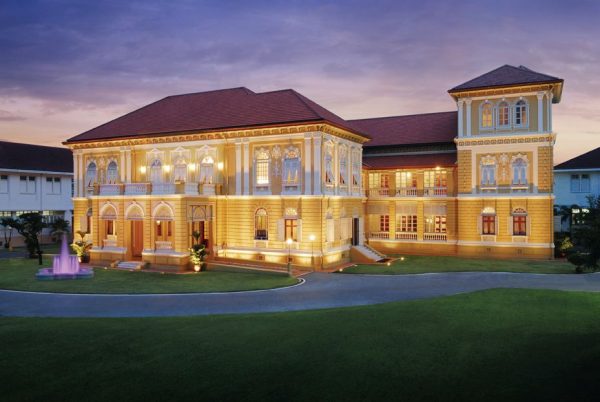

©The Crown Property Bureau
Anti-establishment protesters have intensified their push for change at the top of Thai society with a plan to gather at the Crown Property Bureau on Wednesday (November 25).
The protesters, who have been calling for reform of the monarchy since August, promised to spring “a big surprise” at the rally.
Panupong “Mike” Jadnok, a key figure of the student-led Ratsadon (People’s Group) movement, said last week that they would “demand the return of taxpayers’ money”.
Protest leader Arnon Nampa included the hashtag “#Nov25ProtestForReturnOfNationalAssets” in his recent Facebook post about the upcoming protest.
The Free Youth group, organiser of recent anti-establishment protests, offered a Facebook rallying cry: “See you at the Crown Property Bureau on November 25! There will be no compromise.”
Prime Minister Prayut Chan-o-cha, meanwhile, responded on Monday by questioning the protest leaders’ plan.
“Why they want to get close to the Crown Property Bureau? I think you know their purpose, so there’s no use asking me,” he told reporters at Government House.
The Metropolitan Police have warned that the Crown Property Bureau is “royal ground” and considered off-limits for protest according to the Public Assembly Act. The law prohibits public assembly within a 150-metre radius of royal buildings.
The protest also comes less than a week after the prime minister vowed to enforce “all laws” against protesters, raising concern that the lèse majesté law (Article 112 of the penal code), will be used to quell the political turmoil.
Article 112 carries severe prison terms for criticism of the monarchy but has not been enforced for more than two years. General Prayut disclosed in June that its use had been suspended at royal request “due to the kindness of His Majesty the King”.
Over the past few months, anti-establishment protesters have been demanding reform of the monarchy along with a new Constitution and the PM’s resignation.
The protesters’ controversial 10-point manifesto for monarchy reform, launched in August, also included the issue of royal assets. The manifesto called for the annulment of the 2018 Royal Assets Structuring Act passed by the post-coup regime. The act combines His Majesty the King’s personal assets and the crown’s wealth managed by the Crown Property Bureau.
To prevent conflicts over the issue, some observers suggested reviving the practice on royal assets observed during the reign of King Bhumibol Adulyadej.
Among them is Kiatnakin Bank chairman Banyong Pongpanich, who called on the people in power to “help defuse the main conflict point peacefully”.
On November 18, shortly after the protesters announced their plan for Wednesday, former Army chief General Apirat Kongsompong was appointed Crown Property Bureau deputy director by royal command.
The appointment came two months after Apirat – a staunch critic of the anti-establishment protesters while he was Army chief – was appointed by royal command as deputy secretary-general of the Royal Household Bureau. He retired from the Army at the end of September.
The Crown Property Bureau was established under the Royal Assets Structuring Act of 1936 and became a legal entity in 1948. It replaced the Royal Treasury that existed up until the 1932 Siamese Revolution, which brought an end to absolute monarchy.
In the early 1900s, the Royal Treasury owned as much as one-fifth of the land in Bangkok, including the key business districts of Si Phraya, Bang Rak and Sampheng, according to a 2006 research paper published by Porphant Ouyyanont of Sukhothai Thammathirat Open University’s School of Economics.
The Royal Treasury invested in real estate and joint ventures with foreigners, including ferry and tram services, beer production and mining, the research paper said.
It also set up Siam Commercial Bank and Siam Cement, which have grown to become large companies today.
In 1960, the Crown Property Bureau began investing in hotels, such as the Dusit Thani, Royal Orchid and Siam InterContinental, BBC Thai reported, citing Porphant’s study.
The Crown Property Bureau invested directly in at least 10 companies, and invested in at least 21 other firms via affiliates.
According to the 2017 BBC Thai report, it also has 1,400 hectares of land in Bangkok and another 4,800 hectares in the provinces.
By Thai PBS World’s Political Desk