

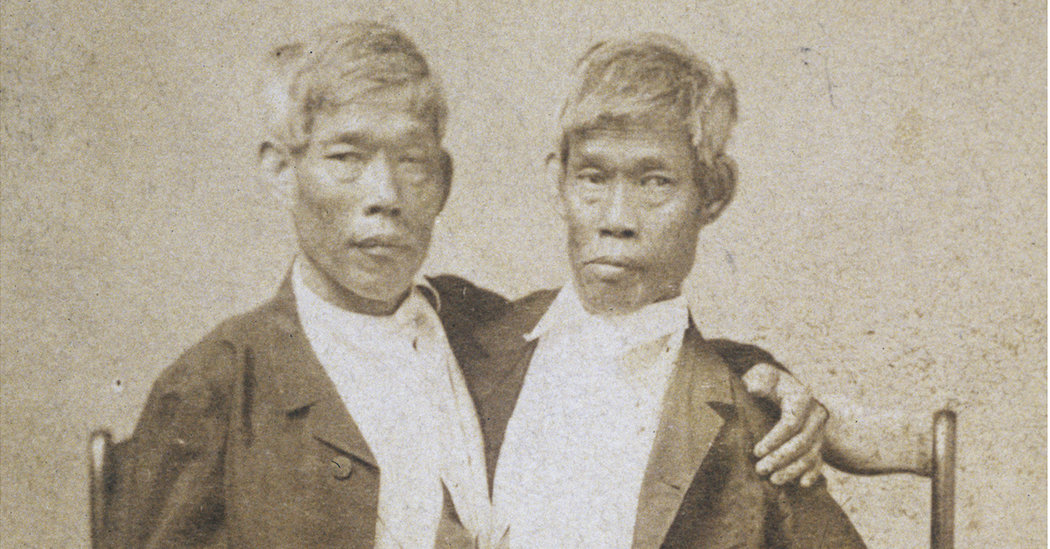
By the time they were 21, the twins had had enough, sick of being treated like possessions, traveling in steerage while their manager slept in first class, forced to perform when they were sick or simply bone-tired. So they struck out on their own, eventually making enough money to retire from the exhausting and degrading life they had shared for so long. They bought a house in Mount Airy, N.C., and, to widespread outrage, married two Southern sisters — overcoming not only their brides’ initial reluctance and the shocked, adamant objections of the girls’ father but also the laws of the land, which forbade mixed-race marriage.
Huang devotes an entire chapter, more than enough for most readers, to how the twins and their wives likely dealt with the obvious challenges related to the most intimate aspect of their marriage. Over time, and out of an increasing necessity, Chang and Eng had developed what Huang describes as “alternate mastery,” with one twin completely yielding to the will of the other, “a sort of self-imposed ‘blanking out,’ a mental withdrawal.” The twins took turns being dominant or docile, whether working on their farm, playing chess or increasing their large family, which began with a healthy child for each of them just 10 months after their double wedding and quickly grew to 21 children between the two families.
It’s difficult to follow the course of Chang’s and Eng’s lives without being impressed by their courage and determination in the face of extraordinary obstacles and prejudice, but one fact casts a deep shadow over everything they achieved: As inhabitants of the American South, and devout Confederates during the Civil War, they bought, owned and sold slaves. Having essentially been sold into indentured servitude themselves when they were still only children, and knowing far too well what it felt like to be treated as less than human, they did not shrink from subjecting others to an even worse fate.
In Chang and Eng, Huang has taken on a complex subject. To help explain the twins’ place not just in their own world but in ours as well, he enlists the help of anthropologists, botanists, novelists, essayists and philosophers. He crosses continents, centuries and fields of study, quoting everyone from Thomas Hobbes and David Hume to Jane Austen and Edgar Allan Poe, to name only a few. In the end, however, the impression that the reader is left with is that Chang and Eng were less affected by how society treated them than by the fact that they could never be free of each other, would never fully be, as they once put it, “their own men.”
Over time, the thick band that bound them together stretched to nearly six inches, giving them another precious inch and a half of distance. For years, they had consulted doctors across the country, had even asked to be separated at the risk of their lives, but they never achieved their freedom. The fact, then, that these two fiercely independent men would enslave other human beings, subjecting them to the same torment that they themselves could not escape, is not only difficult to understand but impossible to forget. It is perhaps the most telling detail in their extraordinary lives, a poignant reminder that what makes us human is not our ability to look the part but our willingness to see ourselves in someone else.