

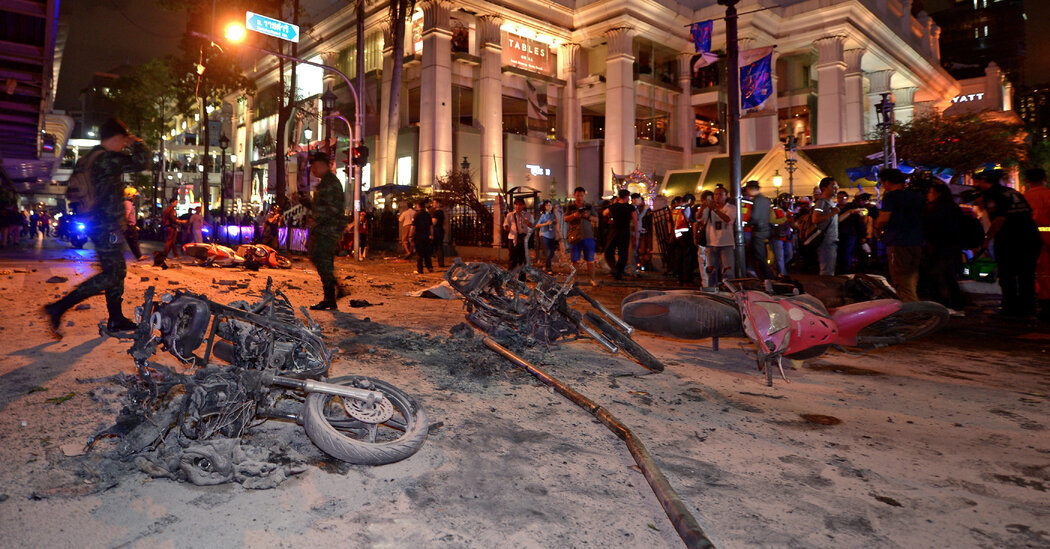
Two men were sentenced to death on Thursday for their roles in the deadliest terrorist attack in Thailand’s modern history, the 2015 bombing of a Bangkok shrine that killed 20 people and injured more than 120.
A Thai court convicted the two men, Bilal Mohammed and Yusufu Mieraili, who are members of the Uyghur Muslim minority group and had been in custody for 10 years, of premeditated murder. They have consistently denied the charges, and their lawyer told reporters they would appeal the ruling.
The verdict brought to a close one of Thailand’s longest-running criminal proceedings, which was slowed by difficulties in securing Uyghur speaking translators and the Covid-19 pandemic. The case has been criticized by the United Nations and human rights groups, who have said the men were not given a fair trial.
In October 2025, the U.N. Human Rights Council Working Group on Arbitrary Detention said that the defendants’ decade-long detention “was fundamentally arbitrary, discriminatory, and breached international covenants.”
The attack in 2015 targeted the Erawan Shrine, a Hindu shrine located in the heart of downtown Bangkok that is popular with both Thais and foreign tourists, especially from China and the Chinese diaspora. Six of the dead were Thai and five were from mainland China.
While nobody claimed responsibility for the attack, Thai news media at the time speculated that it was revenge for the deportation of 109 Uyghurs, who face persecution in their homeland of Xinjiang, back to China. Weeks after the attack, the Thai police chief described it as retaliation for the police breaking up a trafficking pipeline that smuggled Uyghurs across Southeast Asia. But that explanation was widely challenged, including in the Thai media.
The bombing also coincided with a series of explosions that occurred throughout the country after the Thai military seized power in a May 2014 coup. The junta initially blamed the “Red Shirt” protesters, supporters of former Prime Minister Thaksin Shinawatra, for the bombing.
But after a massive manhunt, the Thai authorities arrested Mr. Bilal following a raid at an apartment, where they found a large cache of bomb-making materials and forged passports. They matched him to CCTV footage that showed a man placing a rucksack at the shrine just moments before the blast. His lawyer has argued that the two men do not look alike.
Investigators matched Mr. Yusufu’s fingerprints to a container of gunpowder found in the apartment that they raided, and arrested him on the Thailand-Cambodia border.
“RIP Thailand’s justice system,” Mr. Yusufu, 36, yelled out in the court after Thursday’s sentencing. “I don’t accept any of this. I didn’t do anything wrong.”
Mr. Bilal, 41, repeatedly told the court that he had been subjected to ill-treatment by the Thai authorities in order to extract a confession, according to the International Federation for Human Rights. He said he had been denied access to a Uyghur interpreter throughout the investigation and forced to sign documents written in Thai, which he does not understand.
The court also imposed a 1.5 million baht ($46,000) fine, ordering the men to pay for damages caused to the shrine, as well as a nearby hospital and hotel.
When reached by telephone, Pakkapol Singro, whose brother Yutthanarong Singro died in the bombing, said he did not even know that there would be a verdict today. He said after five years, he stopped following updates on the case.
“It’s great news that finally they got punished for their acts, especially after waiting for so long,” Mr. Pakkapol said.
Sunai Phasuk, a researcher on Thailand for Human Rights Watch, said the Thai authorities had failed to examine the allegations of torture and mistreatment meted out to Mr. Bilal and Mr. Yusufu.
“Shoddy investigations and cover-ups have left key questions about the secretive networks behind the Erawan Shrine bombing unanswered,” he said.
Thailand has come under heavy criticism for its treatment of the Uyghurs, who have used the Southeast Asian country as a transit point on their way from China to Turkey, which is home to a sizable Uyghur community. In China, Uyghurs have, in recent years, been detained in internment camps, subject to birth control measures and placed under heavy surveillance.
Last February, Thailand deported 40 Uyghur asylum seekers back to China, drawing a sharp rebuke from U.N. officials and activists who warned that the men could face torture and long-term imprisonment upon their return. Some analysts saw the move as an indication of China’s growing clout in Thailand, a U.S. ally that has become increasingly close to Beijing.
Kittiphum Sringammuang contributed reporting.