

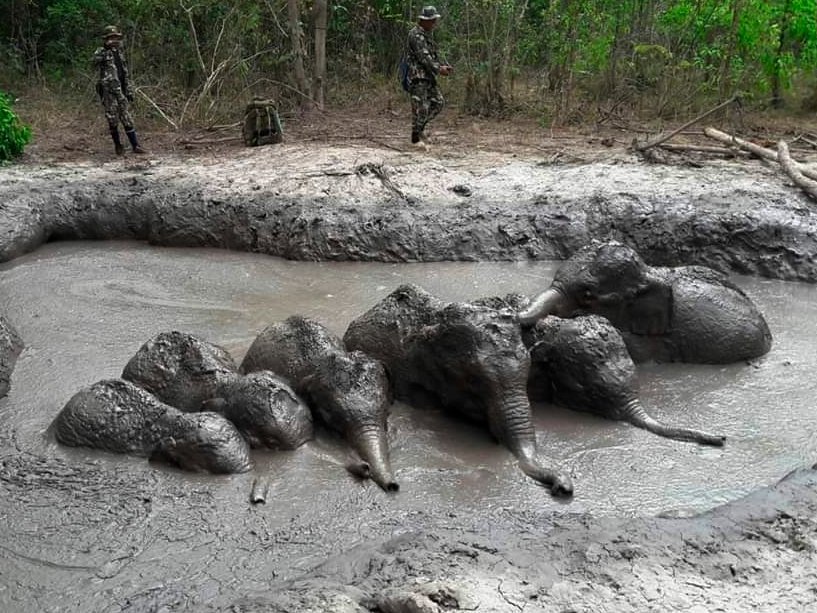

Six baby elephants who were trapped in a mud hole and separated from their parents have been rescued in northeastern Thailand.
Park rangers came across the elephant calves on Wednesday afternoon as they were struggling to climb the pit’s slippery banks, officials of Thap Lan National Park said.
Some of the rangers went to get help, while others spent the night with the baby elephants.
On Thursday, as the elephants wallowed together at one side of the pit, rangers at the other side spent four hours using hoes and pickaxes to dig out enough mud to form a ramp.
Footage of the rescue released by the Department of National Parks shows the animals climbing out of the muck one by one and quickly heading into the forest, a few dozen metres away.
1/9 Monkey shows
Chimpanzees are forced to perform demeaning tricks on leashes and are often subject to cruel training techniques. Animals who are confined to small, barren enclosures and forced to perform unsurprisingly show symptoms of stress and depression. Chimpanzees have been documented rocking back and forth, sucking their lips, salivating and swaying against enclosure perimeters in distress.
Getty Images
2/9 Swimming with dolphins
Some marine parks use bottlenose dolphins in performances and offer visitors the opportunity to swim with dolphins. Unfortunately, people are often unaware that these animals are captured in the wild and torn from their families or traded between different parks around the world.
Getty Images
3/9 Tiger shows
Tigers are forced to live in an unnatural and barren environment and have to endure interactions with a constant stream of tourists. Since tigers never lose their wild instincts, across the world they are reportedly drugged, mutilated and restrained in order to make them “safe” for the public. However, every year, incidents of tiger maulings are reported at this type of tourist attraction.
Getty Images
4/9 Donkey rides
Sunning on the beach is great for humans – we can take a quick dip or catch a bite to eat when we get too hot or hungry. But it’s pure hell for donkeys who are confined to the beach and forced to cart children around on the hot sand. Some donkey-ride operators at beach resorts in the UK even keep the animals chained together at all times.
Getty Images
5/9 Marine parks
Some parks confine orcas to concrete tanks and force them to perform meaningless tricks for food – many die in captivity. Orcas are highly intelligent and social mammals who may suffer immensely, both physically and mentally, when they’re held in captivity.
Getty Images
6/9 Canned hunting
Lions are confined to fenced areas so that they can easily be cornered, with no chance of escape. Most of them will have been bred in captivity and then taken from their mothers to be hand-reared by the cub-petting industry. When they get too big, they may be drugged before they are released into a “hunting” enclosure. Because these animals are usually kept in fenced enclosures (ranging in size from just a few square yards to thousands of acres), they never stand a chance of surviving.
Getty Images
7/9 Running of the Bulls
Every year, tourists travel to Pamplona for the Running of the Bulls. The bulls who are forced to slip and slide down the town’s narrow cobblestone streets are chased straight into the bullring. They are then taunted, stabbed repeatedly and finally killed by the matador in front of a jeering crowd. The majority of Spaniards reject bullfighting, but tourists are keeping the cruel industry on its last legs.
Getty Images
8/9 Horse-drawn carriages
City streets are no place for horses. The animals toil in all weather extremes, suffering from respiratory distress from breathing in exhaust fumes as well as numerous hoof, leg and back problems from walking on pavement all day long. As easily spooked prey animals, horses subjected to the loud noises and unexpected sounds of city streets are likely to be involved in accidents, even deadly ones.
Getty Images
9/9 Zoos
The zoo community regards the animals it keeps as commodities, and animals are regularly bought, sold, borrowed and traded without any regard for established relationships. Zoos breed animals because the presence of babies draws visitors and boosts revenue, yet often, there’s nowhere to put the offspring as they grow, and they are killed, as we recently saw with Marius the giraffe in Denmark. Some zoos have introduced evening events with loud music and alcohol which disrupt the incarcerated animals even further.
EPA
1/9 Monkey shows
Chimpanzees are forced to perform demeaning tricks on leashes and are often subject to cruel training techniques. Animals who are confined to small, barren enclosures and forced to perform unsurprisingly show symptoms of stress and depression. Chimpanzees have been documented rocking back and forth, sucking their lips, salivating and swaying against enclosure perimeters in distress.
Getty Images
2/9 Swimming with dolphins
Some marine parks use bottlenose dolphins in performances and offer visitors the opportunity to swim with dolphins. Unfortunately, people are often unaware that these animals are captured in the wild and torn from their families or traded between different parks around the world.
Getty Images
3/9 Tiger shows
Tigers are forced to live in an unnatural and barren environment and have to endure interactions with a constant stream of tourists. Since tigers never lose their wild instincts, across the world they are reportedly drugged, mutilated and restrained in order to make them “safe” for the public. However, every year, incidents of tiger maulings are reported at this type of tourist attraction.
Getty Images
4/9 Donkey rides
Sunning on the beach is great for humans – we can take a quick dip or catch a bite to eat when we get too hot or hungry. But it’s pure hell for donkeys who are confined to the beach and forced to cart children around on the hot sand. Some donkey-ride operators at beach resorts in the UK even keep the animals chained together at all times.
Getty Images
5/9 Marine parks
Some parks confine orcas to concrete tanks and force them to perform meaningless tricks for food – many die in captivity. Orcas are highly intelligent and social mammals who may suffer immensely, both physically and mentally, when they’re held in captivity.
Getty Images
6/9 Canned hunting
Lions are confined to fenced areas so that they can easily be cornered, with no chance of escape. Most of them will have been bred in captivity and then taken from their mothers to be hand-reared by the cub-petting industry. When they get too big, they may be drugged before they are released into a “hunting” enclosure. Because these animals are usually kept in fenced enclosures (ranging in size from just a few square yards to thousands of acres), they never stand a chance of surviving.
Getty Images
7/9 Running of the Bulls
Every year, tourists travel to Pamplona for the Running of the Bulls. The bulls who are forced to slip and slide down the town’s narrow cobblestone streets are chased straight into the bullring. They are then taunted, stabbed repeatedly and finally killed by the matador in front of a jeering crowd. The majority of Spaniards reject bullfighting, but tourists are keeping the cruel industry on its last legs.
Getty Images
8/9 Horse-drawn carriages
City streets are no place for horses. The animals toil in all weather extremes, suffering from respiratory distress from breathing in exhaust fumes as well as numerous hoof, leg and back problems from walking on pavement all day long. As easily spooked prey animals, horses subjected to the loud noises and unexpected sounds of city streets are likely to be involved in accidents, even deadly ones.
Getty Images
9/9 Zoos
The zoo community regards the animals it keeps as commodities, and animals are regularly bought, sold, borrowed and traded without any regard for established relationships. Zoos breed animals because the presence of babies draws visitors and boosts revenue, yet often, there’s nowhere to put the offspring as they grow, and they are killed, as we recently saw with Marius the giraffe in Denmark. Some zoos have introduced evening events with loud music and alcohol which disrupt the incarcerated animals even further.
EPA
The rangers cheer the elephants on, with comments like “Go, go on, child!”
One elephant can be seen to struggle, slip and fall, but finally all make it out of the muck.
The last of the animals then lingers, after all the others have made it past the tree line.
It faces the rangers for a moment, turns, pauses and finally runs into the jungle.
“Gone, they’re gone,” cries a ranger, as the rescue crew comes together to celebrate.
Park chief Prawatsart Chantep said there were signs a herd of elephants believed to be related to the trapped infants was circling the area.
Elephants are the official national animal of Thailand, and for a time graced the country’s flag when it was still called Siam.
But development has sharply reduced their natural habitat and shrunk their numbers. They are notorious for raiding farmers’ fields for food, especially sugar cane.
Several people are killed each year by angry elephants.
Last November, a driver on a road near another park in the northeast struck the hind legs of one when it wandered out of the jungle at dusk. The animal responded by stomping on the car, destroying the engine and killing the driver.
Additional reporting by Associated Press
We’ll tell you what’s true. You can form your own view.
At The Independent, no one tells us what to write. That’s why, in an era of political lies and Brexit bias, more readers are turning to an independent source. Subscribe from just 15p a day for extra exclusives, events and ebooks – all with no ads.