

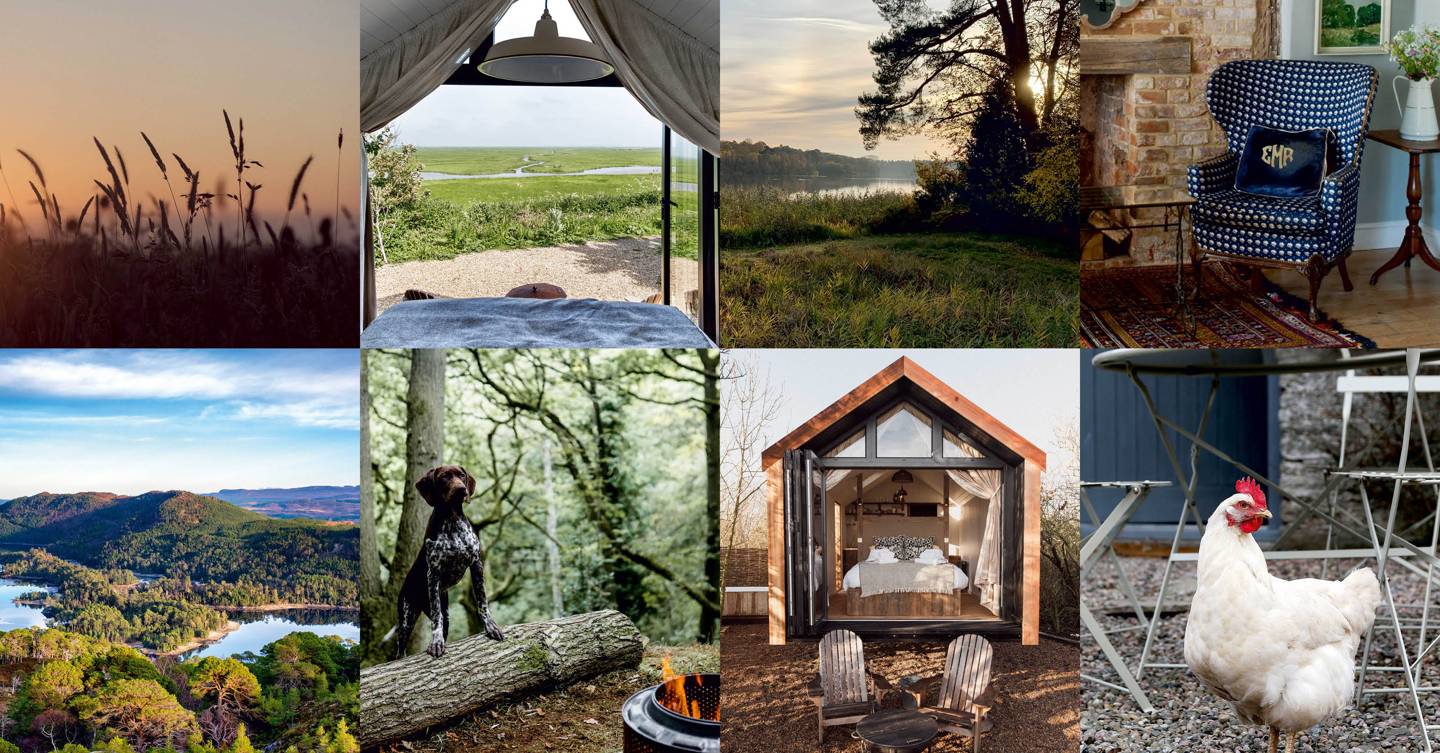
5 initiatives bringing life back to the countryside

Kyle House, part of Scotland’s Wildland
Martin Kaufmann
Wildland, Scotland
In 1959, nature writer Calum Maclean described Sutherland on Scotland’s north coast as ‘the most desolate if not the most beautiful of all the counties’. In the heart of such wilderness is the Kyle of Tongue, an inland sea surrounded by the last craggy outposts of the mountains as they cascade from Ben Hope and Ben Loyal. Here, the Wildland Kinloch Estate is in the midst of transformation. Lichen-laden larch trees dangle over ice-cold streams, heather plummets into inky-blue lochans and golden eagles soar overhead. It is thanks to Danish billionaires Anders and Anne Holch Povlsen. In 2007, they set up Wildland, a 200-year vision to protect more than 200,000 acres of Scottish countryside across 12 estates (in Sutherland, the Cairngorms and the west). The plan to undo years of land mismanagement is the most extensive conservation project in the UK. With Scandi touches and locally commissioned art and interiors, Wildland also has some of the movement’s most elegantly designed estates, lodges and cottages. ‘It’s incredible what nature will do when herbivores are reduced in numbers; seedlings that have lain dormant for years are springing back to life. By reducing deer numbers our Caledonian pine forest has doubled in 15 years,’ says Wildland’s conservation director Thomas MacDonell. Despite concerns over such extensive private land ownership, the vision is compelling – there’s the potential here to revive complete ecosystems.

Shepherd hut at Elmley
Rebecca Douglas
Elmley, Kent
Past a swirl of concrete bridges and power stations, Elmley’s mile-long drive, lapped by a sea of green, feels all the more impressive. It’s set on the southern side of the Isle of Sheppey, beyond watercourses that undulate like slow worms through a bronze throng of reeds. The sheer expanse feels foreign, somehow, and I half expect a tornado to come crashing through, tearing up the charcoal-coloured barns and bird hides. This 3,200 acres of marshland is the UK’s only family-owned and run national nature reserve. Back in the 1980s, long before rewilding was part of the vocabulary, Philip Merricks was determined to prove that farming and wildlife could sit side by side. Since then, arable has been banished and cattle and sheep numbers have been reduced. It’s worked. Birdlife has thrived; 14 short-eared owls visited in 2019 and more than 400 lapwings fledged from the marsh. Since inheriting the farm from her father, Georgina Fulton and her husband Gareth have been keen to appeal to a broader audience. ‘We’re using farming to achieve a wildlife outcome and a food outcome,’ says Gareth, ‘and it’s good to share that with people.’ The restored farmhouse B&B (with far-reaching views, rolltop tubs), shepherd huts and events bring in quite a different crowd from the twitchers.

WILD ENNERDALE, LAKE DISTRICT
We often think of the Lakes as untamed enough, those great expanses of water and fell, the Romantic wanderings; but from a diversity point of view, they are surprisingly barren, over-grazed by sharp-footed sheep and over-planted with conifer. Cradled by the peaks of Great Gable and fed by one of England’s wildest rivers, Ennerdale is the Lake District’s prized back-to-nature project. Galloway cattle churn and chomp their way through an increasingly dense and textured forest while the Liza’s unfettered waters surge the floodplains one season and shrink to a debris-strewn trickle the next. Once bereft of life, the uplands now have plants such as mountain eyebright and the impossibly delicate starry saxifrage. Sightings of red squirrel, merlin and green woodpecker are more common; there’s hope that beavers and pine martens will be too. ‘It’s a place to be connected to the kind of nature you don’t find in the busier parts of the Lake District,’ says Ennerdale’s Rachel Oakley, ‘and it’s a spark of hope in the face of our biodiversity crisis.’ That hope hangs on the rare partnership between three hefty landowners, which include the National Trust. Neither landowner nor community is restricted by boundaries: farming integrates with forestry, rivers connect to floodplains, woodland merges with scrub and wildlife moves freely. Understandably, there’s caution when it comes to ecotourism. While there are 30 miles of car-free trails to explore by foot, bike or horseback, Wild Ennerdale is not out to attract large numbers of visitors (especially as in 2020 the Lakes suffered one of the worst-ever assaults of overtourism), but instead create a holistic balance where, as Oakley says, ‘nature is abundant, the landscape is resilient and people can thrive within it’.
Address: Wild Ennerdale, Forestry Commission, Peil Wyke, Bassenthwaite Lake CA13 9YG
Website: wildennerdale.co.uk

Glen Affric at Trees for Life
TREES FOR LIFE, SCOTLAND
Halfway between Loch Ness and Loch Cluanie on a road that eventually reaches Skye, the terrain of the Dundreggan Estate – Dragon’s Valley in Gaelic – is typical of the Highlands. Pinewoods rise from a carpet of blaeberry and patches of dwarf birch scrub and juniper cling to the hillsides. The River Moriston rips through rocky outcrops, the surface erupting occasionally as an osprey swoops to catch fish. On higher ground, what would have once been the Caledonian Forest is now mostly bare. We are so acclimatised to these big, open views that we have come to see them as beautiful, but Trees for Life thinks otherwise. In 2008, the charity bought the former hunting estate’s 10,000 acres to restore what was left of its natural habitats, although scientists soon discovered more biodiversity than hoped for amid the woodland and hazy wildflower meadows, recording rare creatures such as sawfly and the strawberry spider, and, most recently, nesting golden eagles – the phoenix of the glens. And after finding thousands of native seeds, Trees for Life established a nursery specialising in hard-to-grow species including rowan, oak, aspen and birch. Wildlife reintroductions are also part of the plan, with wild boar and pine marten spotted from the many hides. Years of destruction make tree-planting necessary, drawing volunteers here for weeks or months – some as part of its Rewild and Recover mental-health programme, and many staying in Glen Affric’s Athnamulloch bothy, moments from the River Affric’s wild-swimming spots. The UK’s first rewilding centre is set to launch here in 2022. Restorative and all-embracing, this makes for a more hands-on experience than other conservation-minded estates.

DROVER’S REST, HEREFORDSHIRE
This is a county defined by its overgrown lanes, forgotten farms and wistful sense of rural nostalgia, and it doesn’t get much more remote than the bottom of Watery Lane. The Black Mountains loom a few miles away and fields roll alongside a common thick with bracken. ‘We knew we would move here by the time we’d reached the end of the lane,’ says Kesri Smolas, recalling the day she and her husband Paul first came to the 40-acre farm. The South African couple spent 12 years in London before heading to Herefordshire for a lifestyle shift; having created a glamping and events outfit that exudes easy-going hospitality every step of the way, rewilding plans are now afoot. ‘What excites me most is that when nature is left to its own devices, the landscape can look quite African – take Knepp’s scrubby savannahs and grassy plains,’ says Kesri. ‘There’s an obsession with neatness in this country that I’ve never understood.’ Her thoughts echo those of other conservationists keen to shift our perception of beauty. Thanks to the income from their other projects, the pair can afford to set aside land for rewilding, but also recognise that collaboration is critical. This year, fences between Drover’s and a neighbouring farm will come down to allow for linked-up conservation efforts. Hares, hedgehogs, horses, cattle, pigs, deer and many other species are part of the plan. ‘When I can hear a cacophony of insects, I’ll know we’re getting somewhere,’ says Kesri. Through such collaboration, the aim is to create 230 rewilded acres that will prove anyone can do their bit.
Address: Drover’s Rest, off Watery Lane, Hay on wye HR3 6AG
Website: droversrest.co.uk
In the parkland surrounding Somerleyton Hall in Suffolk, Scots pines and modest oaks fringe a sea of golden grass, disturbed only by rusty-brown survivors of summer’s thistle and the dark shadows of Welsh black cattle. In autumn, the gentle landscape seems settled in the season’s orange glow – even the Italianate towers of the Jacobean country house echo the colour scheme. Walking around the estate’s 5,000 acres with its hereditary resident, Hugh Somerleyton, I’m reminded that UK conservation efforts often follow an over-familiar narrative of wealth, ego and exclusivity – landowners set on well-meaning yet unattainable missions – but I soon realise this one is different.

Somerleyton Hall, the home of Wild East founder Lord Somerleyton
The most recent of the country’s regeneration projects, Wild East was set up in 2020 by Somerleyton, Ollie Birbeck and Argus Hardy. It aims for 20 per cent of East Anglia to be returned to nature. ‘Having earnest rich people talk about it is not motivating for most people, especially farmers,’ says Somerleyton as we scramble down a forgotten patch of woodland towards the silvery, marshy edge of the River Waveney.

European brown hare at Elmley in Kent
Martin Kaufmann
Upstream, it carves a border between Suffolk and Norfolk; a few miles below, it trickles out to sea at Great Yarmouth. His two terriers, Archilles and Judas, lead the way, eager to reach a tangle of reeds and rushes criss-crossing towards a lonely mill. ‘If we want to bring nature back, we need to make the conversation relevant to a broader group of people,’ he adds.

Sunset at Elmley in Kent
Rebecca Douglas
Wild East gathers together a patchwork of initiatives across a 1,500-square-mile landscape that stretches from The Wash to the Thames Estuary. Anyone can pledge a portion of their land, so the commitments range from a plot of un-mown garden to 500 acres of the Massingham Estate. Although influenced by rewilding pioneers such as Charlie Burrell and Isabella Tree at Knepp Castle Estate in Sussex, and Paul Lister’s often controversial campaigns to bring back wolves at Alladale in Scotland, the mission here has a sense of pragmatism. But debate is still welcome, which is why a lynx – a potential reintroduction to East Anglia – sits defiantly on the Wild East logo.

As we cross rutted fields and water-logged tracks, a fallow deer darts into a thicket and a flock of buntings swirl above the mud like a swarm of bees. ‘We’re just going back to how my father’s farm manager did it 50 years ago – before big machinery and efficiency took over.’ Somerleyton jumps enthusiastically from one scheme to the next. Rotating crops, restoring heathland, introducing bison (something of a heavyweight rewilding pin-up, despite not being native to England). Commercially, it relies on optimism and the hope that in 20 years or so the demand for low-cost meat will dramatically reduce. It’s clearly a work in progress. In the woods by Fritton Lake, choking rhododendrons from the Victorian era have already been cleared to create a new ecosystem for waders at the water’s edge. Ten or so large black pigs break up the soil and bracken, their snouts playing an essential role in the regeneration process.

The Shed on Fritton Lake estate in Norfolk
The estate can be visited for the day but it’s far better to stay the night at the 16th-century Fritton Arms – with roaring fires and a menu packed with local blackberries and venison sausages – or one of the woodland cabins and cottages. From here, you can dip into wild swimming, take boat safaris around the two-mile lake or drift around the pool, a log fire warming the towels. During a jog along the shore, I come face to face with muntjac, and am startled when several pikes send sprats shooting out of the water like silver bullets. Later, I join Fritton Lake’s forager, Matthew Stevenson, to dive into the woods to find chanterelles, bracket fungi, bonnets and stinkhorn. ‘You must never forage the lot; leave some for nature and keep the mycelium intact,’ he says. ‘Be mutualistic rather than parasitic.’ By the end of the walk I’m hugging a ginkgo tree and being told to feel the energy in its veins.
The whole place manages to appear cared for but not at all polished – Somerleyton views complaints about the ‘messy’ long grass as a success. ‘You never know what you’re going to get with him,’ Stevenson tells me.‘The other day he asked me to make sure lizards can still get in and out of the covered-up footgolf holes.’ It will take time for the estate to thrive under this passionate custodianship, and for wider ambitions to ripple out around East Anglia. What does seem sure is that, while many rewilding projects feel out of reach, everyone will be welcome to join the Wild East mission; an approach that’s long overdue. wildeast.co.uk
For more on rewilding, visit rewildingbritain.org.uk and healrewilding.org.uk
Keep scrolling for more images…
Like this? Read more:
10 stays in the UK that contribute to conservation projects
7 brilliant farm stays in the UK
Our favourite sustainable hotels in the UK