

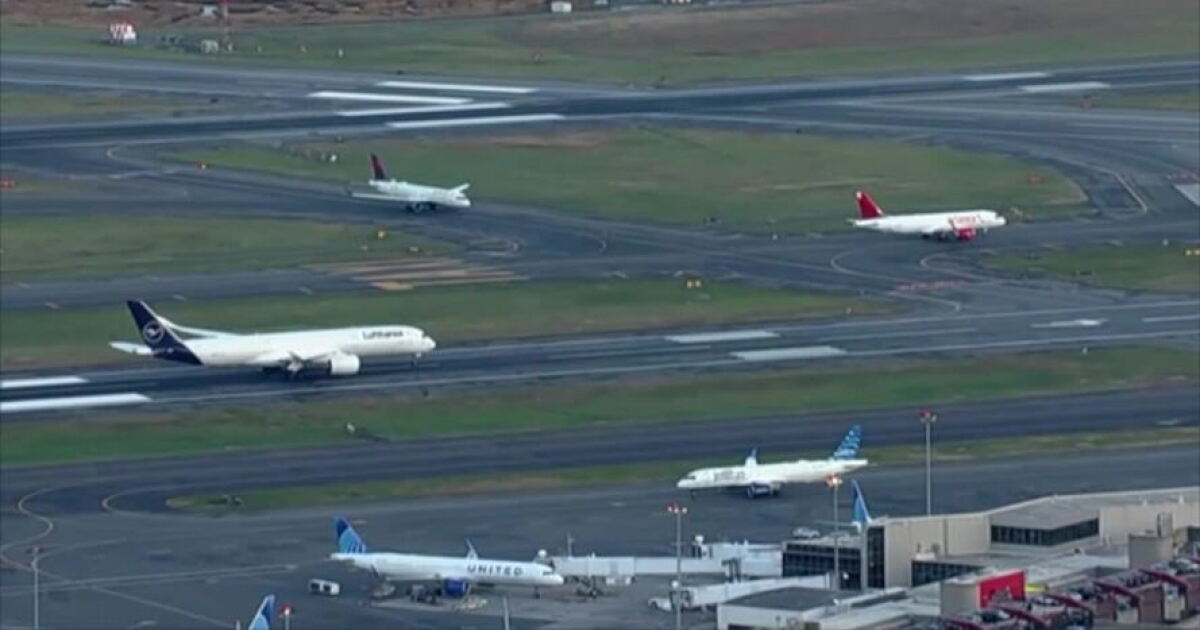
The Federal Aviation Administration ordered a rare nationwide ground stop Friday, an action so unusual it has happened only a handful of times in recent history.
In the last hour, the ground stop was finally lifted.
WATCH | FAA orders rare nationwide ground stop, only the third in recent history FAA orders rare nationwide ground stop, only the third in recent history
The ground stop came just one day after a massive global Microsoft outage that knocked out communication services around the world. While the timing may seem suspicious, Homeland Security Secretary Markwayne Mullin says it’s coincidental, calling that communications outage a separate issue.
Looking back, there are only two other times in recent memory when something of this magnitude happened. I spoke Friday afternoon to aviation expert Reed Yadon, who explained that this is the first nationwide ground stop since January 2023, when a key FAA computer system malfunctioned.
WATCH | Reed Yadon shares insights on ground stop Aviation expert shares insight into extraordinary circumstances grounding flights
“That one was an equipment failure. So, the cause is a little bit different, but the end result is the same. You’ve got to stop handling aircraft. You’ve got to get them on the ground. Get the system up and running again and then feed the aircraft back into the system, get people where they’re going. The longer we’re shut down, the longer it’s gonna take to straighten it out,” Yadon said.
Before that, the last nationwide ground stop came after the Sept. 11, 2001, attacks. Secretary Mullin said Friday there was no indication that this was a nefarious attack against the U.S., calling it “just a telecommunications outage.”
“We had people attacking the nation on 9/11. Rogue aircraft were flying around, flying into buildings, they weren’t sure what else was out there, so the only way to cure it was to get everything on the ground, stop everything. This one’s a lot different,” Yadon said.
Friday’s outage comes as the FAA is spending $12.5 billion to rebuild an air traffic control system still reliant on decades-old technology. The goal is to replace aging radar, copper wiring and other obsolete equipment by 2028.
The FAA says 68 percent of its old copper telecommunications network has now been replaced with fiber.
But Yadon says the system can still have a critical weakness.
“Today, it’s mostly fiber running between all these centers. And you take out a couple of the main hubs and the whole thing collapses,” Yadon said.
Nationwide ground stops are extremely rare, but regional restrictions aren’t. We saw one here in Las Vegas this summer, when a controller shortage forced the FAA to slow flights into Harry Reid.
Those restrictions can be caused by staffing, weather or equipment.
What makes this one so unusual is the scale: a communications failure affecting air traffic control centers nationwide.