

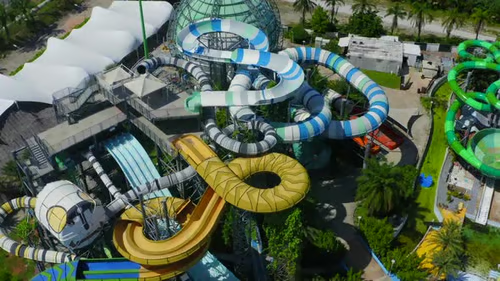
With its mouth agape, the giant lion’s head is frozen in a roar. No water rushes down the log flume that descends from its heights, while at ground level, the vast amusement park stands empty of noise and activity except for leaves blowing in a light breeze.
Welcome to Siam Amazing Park, billed as the longest-running amusement park in south-east Asia, and certainly in Thailand. Up to a million people rush in every year for thrills on rides like the Boomerang, an orange rollercoaster that loop-the-loops at 80km/h (50mph), or to splash around under the tropical sun in one of the world’s largest wave pools.
It now stands empty, after being closed late last month when it started raining in Bangkok and did not stop for days. It could take more than six months for the park to reopen.
Managing director Wuthichai Luangamornlert sits in an airconditioned conference room at the park’s entrance. Below his office, rows of turnstiles stand empty where just days before, thousands of tourists and local visitors were eagerly pushing through.
He was not too alarmed when the rains began at the end of September. The area on the outskirts of Bangkok has seen heavy rains before – the megacity itself is built on floodplains and has a network of muddy canals and pumps to drain water.
“When it rains a lot, it will dry off and the water will go away by the next morning,” he says. But the next morning came and it was still raining, and the day after, it was still raining. “The water level keeps rising. So that’s when we knew that it was not normal.”
After three days, the sewers filled up and much of the park turned into a giant lake, with the water level reaching around knee height. Many of the motors and electrical systems that power the rides were damaged. Buildings around the park are still marked with lines of silt – the markers a flood leaves behind.
Wuthichai’s father, Chaiwat, who opened the park in 1980, is famous in Thailand for his rags-to-riches tale, and kept prices discounted so the average Thai family could afford a rare visit. The son is now managing things, and says it is odd how rapidly his mindset changed from that of little concern to the reality of having the park closed for six months, or longer. “It happened within a few hours,” he says.
This story of unstoppable rising water is one told across the city, where the government declared a flood disaster across all 50 districts. For days, people were forced to use boats to get to their destroyed homes, and those who did not have boats used inflatable pool toys. Weeks later, only puddles are left, although many canals are full and the rainy season is not over.
Climate scientists warn the world is indeed experiencing a slow-moving crisis as the planet bakes due to human-induced heating, although it is too early to attribute Bangkok’s rains to climate breakdown, and the picture is complicated by an abnormally strong El Niño, a cyclical weather pattern that brings violent extremes.
In the water section of the amusement park, dry water slides drop directly into murky flood waters, while deck chairs stand abandoned. Small fish have entered the once-chlorinated waters, making their home in waters turned green with algae which were previously bright azure.
The wider park – which was built to be bursting with children, laughter and blaring music – remains spectacularly eerie.
Stalls offering rice and spicy meat as well as American-style food such as hotdogs stand empty, although their price boards remain outside.
Wuthichai says the park’s primary concern was their several hundred staff. The business is not as strong as it was before the Covid pandemic, he says, when they were forced to close but did not make redundancies. Several rollercoasters are foreign-made and need specialised parts and labour from Europe or Japan that could take months to arrive. At least the double-decker carousel at the park entrance is bespoke and locally made, he adds.
The owners expect the cost of repair, and the lost revenue from being closed, to reach millions of US dollars. Short of cash, they have asked for a debt holiday from banks, help from the government, and are also considering offers to buy the park.
“There are people who are still interested, still making appointments all the time,” says Wuthichai, who sits next to his adult son, the third generation of the family business. “We have not made a decision yet.”