

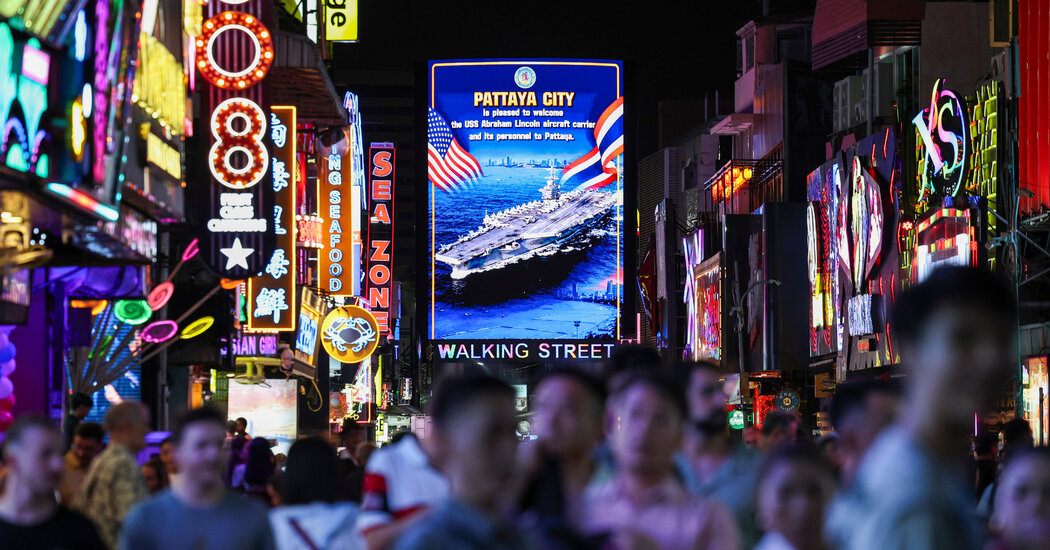
After 286 days at sea, the sailors and Marines of the warship Abraham Lincoln savored the pleasures of Pattaya, Thailand. Their indulgences were not all decadent.
They ate Double Super Cheeseburgers at Burger King. They shopped for LeBron James jerseys at the mall. They sipped from fresh coconuts at the beach, their backs to the water where they had spent the last nine-plus months.
And they danced with scantily clad women at nightclubs, the pounding music seemingly even louder than the aural assault of an aircraft carrier at war.
Pattaya is used to welcoming American servicemen. The beach town grew from an R&R refuge for American military personnel during the Vietnam War. For five days beginning on Wednesday, its pool halls, steakhouses and spas, its go-go bars, burrito shacks and trinket stalls have turned their attention to the 5,000 or so service members from the Lincoln, one of four carriers used in the air campaign against Iran.
After a grueling deployment that fed criticism of the Trump administration’s execution of the war, the service members aboard the Lincoln had been instructed not to speak with members of the news media during their time in Pattaya.
Nevertheless, seven sailors confirmed, on the condition of anonymity, that the carrier’s long months at sea, especially without any of the normal stops at so-called liberty ports, had sapped both supplies and morale. They spoke of clogged toilets and, alarmingly, of multiple suicide attempts. (Navy officials have denied an increase in suicide attempts on the Lincoln.) Amid Iranian missile barrages and drone attacks, the half-day shifts merged into a Sisyphean blur, without the usual relief of care packages from home or treats from the ship store.
Meals were rationed, they said, and offered up a monotony of carbs. What she was really craving, one sailor said, was a salad, something green and fresh. Was there one to be had in Pattaya? There was.
The worst, a sailor from Illinois said, was not knowing how much longer they would be at sea. He stopped counting the days at around 200, despairing that the deployment might never end. Another sailor, a New York native, said that he had gone through a dozen deployments without incident, but this time he had watched junior sailors break, one by one. The price of war, he said, was something he was willing to bear, but not when a logistical crisis, which left the carrier with dwindling supplies, seemed preventable.
Did they, he continued — not defining the “they” — think for a moment about the mental health of those aboard the Lincoln? Defense Secretary Pete Hegseth has said that reports of difficult conditions aboard the Lincoln were “misrepresented.” President Trump opined that the Lincoln’s deployment was “not nearly long enough.”
The residents of Pattaya, at least, appeared to understand the hardship borne by the crew of the Lincoln, which will head next toward its home port, San Diego. Pattaya’s mayor turned up to greet the men and women touching dry land for the first time since November. A gem shop offered discounts to the U.S. Navy and Marine Corps personnel. The Sapphire Club, an adult entertainment venue, dispatched three women in strapless black bodysuits to hold placards offering discounts for those with valid U.S. military ID.
At the Tahitian Queen, which bills itself as the oldest bar in Pattaya, circa 1978, Mickey Foth, one of the owners and an American military veteran and former Pentagon employee, teared up as he considered the sacrifices made by the Lincoln’s personnel.
“It’s not just the physical stress, it’s the emotional toll of such a long deployment,” he said, as a line of women in bikinis, one in an American flag pattern, gyrated onstage. “I want to be here, front and center, to say to these men and women, ‘Thank you for your service.’”
On Thursday night, some of the young sailors blushed amid the sexual maelstrom of Pattaya’s Walking Street, with its touts offering intricate shows involving improbably placed pingpong balls. Others, in the throbbing confines of nightclubs, downed shots and leaned close to female companions. Most of the women were Thai, some were Eastern European and Russian, a few were from neighboring countries like Myanmar and Laos or from as far away as Uganda and Uzbekistan.
Prostitution is illegal in Thailand, but you wouldn’t know it in Pattaya. Ever since American bombing missions took off from a nearby Thai air base during the Vietnam War, the village of Pattaya rapidly expanded its red-light district. Business boomed. With the arrival of the Lincoln, local entrepreneurs talked up the positive effect on Pattaya’s economy.
In earlier decades, some women and girls from Thailand’s poor northeast were sold by their families into sex work in Pattaya. While local aid groups say such human trafficking has waned, the criminalization of prostitution, even as it is openly tolerated, can put prostitutes at the mercy of corrupt forces or periodic crackdowns. In the days leading up to the Lincoln’s docking at a nearby port, the police in Pattaya launched an anti-prostitution raid that, like many before it, seemed to have had little lingering effect, apart from stigmatizing the women.
Today, servicemen are a much smaller demographic in Pattaya, compared to tourists from India, China and the Middle East. Amid the sex shows and vendors selling tubes of personal lubricant, vacationing families toted sleeping children, taking in the scene.
“Pattaya has been able to develop itself as a tourist destination, not only for sex tourism but also for culture, temples, family,” said Chanan Yodhong, a gender and sexual equality activist.
On Thursday night, as some sailors and Marines strolled or sat on the curb reeling from too much to drink, a corps of tourist police stood at attention before scattering into the crowds. There were also volunteer officers, residents who are originally from other parts of Asia, Europe and the Middle East.
Among them was Hooman Peseshk, a native of Iran, who has lived in Pattaya for 10 years. He recognized the irony of his patrolling the streets with a shipful of American sailors returning from the war in Iran. But he loved Pattaya, he said, for its status as a free port, where almost anything goes.
“Nobody wants to fight in a war that was started because of our leaders,” he said. “We are all brothers here in Pattaya.”
Despite the beach town’s reputation, many others from the Lincoln said they had no interest in exploring Play Girlz, KINK or the Harem Ultra go-go club. Instead, they dined poolside at the Hilton. They tried out foot spas where little fish nibbled off calluses. At the Hard Rock Hotel, where the minibar comes stocked with chocolate- and strawberry- flavored condoms, a member of the Lincoln crew said he was planning to spend the night ordering room service for one and watching sports on the big-screen TV.
One sailor said that after so many months aboard the carrier — with its frantic sirens, clattering pipes, screaming jet engines, explosive catapult launches — what he missed most was silence. Pattaya is many things, but it is not quiet. For that the sailor would have to wait.
John Ismay contributed reporting from Washington.