

The idea of jewelry being for everyone has played a big role in Pattaraphan Salirathavibhaga’s design career.
After all, said Ms. Salirathavibhaga, 31, who goes by the nickname Nok, wearing jewelry has been part of human existence for centuries. Yet as much as she has devoted herself to this concept of inclusivity, she nearly didn’t become a jewelry designer.
It all began when she was a student at the Pratt Institute in New York City. “I was going to study interior design, but the classes were full so the only major that was available for me to change to was jewelry,” she said. “How I spent time crafting jewelry was through the lens of an artist, so I created work that was true to myself and expressed my stories.”
Born and raised in Bangkok, Ms. Salirathavibhaga graduated from Pratt in 2017 with a bachelor of fine arts in jewelry design. She returned to Thailand the following year and began devoting herself to her business full time in 2021. This experience made her realize that jewelry was a natural fit for her.
“When I changed my major, I didn’t realize jewelry was a big part of my life, but in hindsight it always has been,” she said. “When I was growing up, my family would give small gold earrings or small gold anklets as gifts. I always liked to open the safes of my grandma and my aunt, and so I played a lot with jewelry.”
Much of her inspiration for jewelry design has been universality.
“I didn’t really see it as belonging to any particular gender,” Ms. Salirathavibhaga explained in a recent video interview from Bangkok. “When I unveiled my first kind of capsule collections, when I was still in New York, the first client was a male client of a male friend of mine who bought an earring.”
That led her to consider imagery that would appeal to everyone, underscored by the fact that Thai culture traditionally has not defined genders.
“The term ‘genderless’ wasn’t a label that I was trying to chase or trying to put it on my jewelry brand itself,” she added. “It started as a passion project and then it didn’t really need a label. I just felt like it suited the definition of genderless as my way of approaching it.”
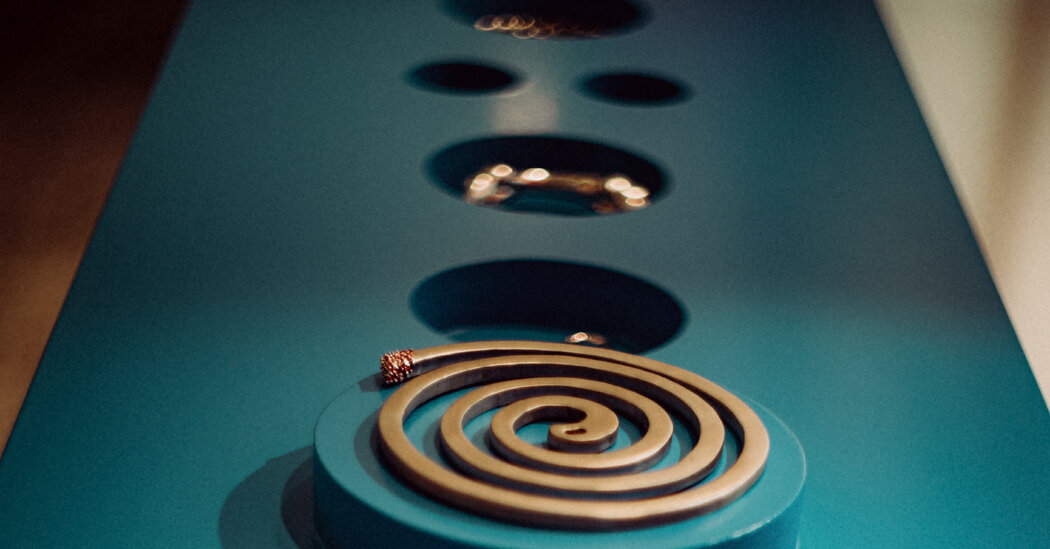
For her fall and winter 2026 collection, available now, she added a few items that celebrate her Thai heritage in not-so-obvious ways — such as the spiral shape of a mosquito coil.
“Anyone who grew up in Southeast Asia remembers putting that in front of the house in the evening,” she said. “It’s a bit of a nod to my heritage, and it’s a really interesting shape.”
Alexander Pickett, a luxury business developer who has worked with Mr Porter and Vacheron Constantin, said the designer’s creations had reflected her identity.
“Pattaraphan brings a Thai traditional styling into her work, but not in an obvious way like Thai text or a religious symbol,” he said in a recent video interview. “The way the styling seeps in is kind of her identity and where she’s from.”
He said one item that exemplified the approach was her mosquito coil design. “That spiral design is in every Thai house, every restaurant, every temple, but who would think to do that?” he said. “No one really notices it as a design, but it’s beautiful.”
Mr. Pickett also considered the genderless approach to be a bit radical, too.
“Most times when you see men’s jewelry, it’s black or traditionally masculine, but I think now the shift is to more genderless stuff,” he said. “It’s the same happening with watches. You find men now wearing smaller watches and women wearing larger watches. I think that kind of genderless thing floats into jewelry as well.”
Bones played a big role in Ms. Salirathavibhaga’s recent pieces, inspired by her own personal experiences several years ago. They did not seem to be an obvious choice, at least not at first.
“I created the bones because I was going through a heartbreak, and I went to a Georgia O’Keeffe exhibition at the Brooklyn Museum in 2017 and I saw for first time her bone paintings,” she said. “The bone paintings resonated with how I was feeling. The bones are remnants of your sadness and your lived experiences, your relationships.”
Another Thai image she has included in her work are elephant tusks, the inspirations for her hook earrings.
“Growing up in Thailand I have always been drawn to elephants, and I visited a sanctuary in the north of Thailand when I was young, and it made a really strong impression on me,” she recalled. “I wanted to take a minimalist kind of approach with the tusk. Simple and elegant.”
Another favorite of hers is the Akani collection, she said. “Akani is Sanskrit for ‘fire,’ and I honor this with the design of matches in earrings and necklaces.”
This fire image comes from her earliest memories, Ms. Salirathavibhaga said.
“I used to spend my time in my grandma’s Buddha room with my twin sister, and we would try really hard to light the yellow candles, which always cooled really quickly,” she recalled, referring to devotional candles. “I wanted to make jewelry that was inspired by that memory of lighting the matches.”
She works mostly in silver but sometimes with gold or brass. And “gemstones slowly creeped into the collections, including white and blue topaz and red garnet,” she added.
She employs seven people for sales and operations, and she outsources the jewelry making to a small independent factory outside Bangkok.“I go there almost every week, so I’m pretty hands on,” Ms. Salirathavibhaga said.
Prices range from $85 to $14,650, and she sells on the company website and Instagram. She also uses such retailers as Zalando, a German online platform; Printemps New York and her own Bangkok boutique in Sukhumvit, a popular tourist area.
Another favorite, though not necessarily associated with her Thai heritage, speaks more to her sense of how it all has evolved.
“One of my motifs is dice, which is something you throw and can’t control the outcome,” she said. “It’s a gesture full of free will and faith, and I felt like my story with jewelry is probably a testament to that.”
Source link