

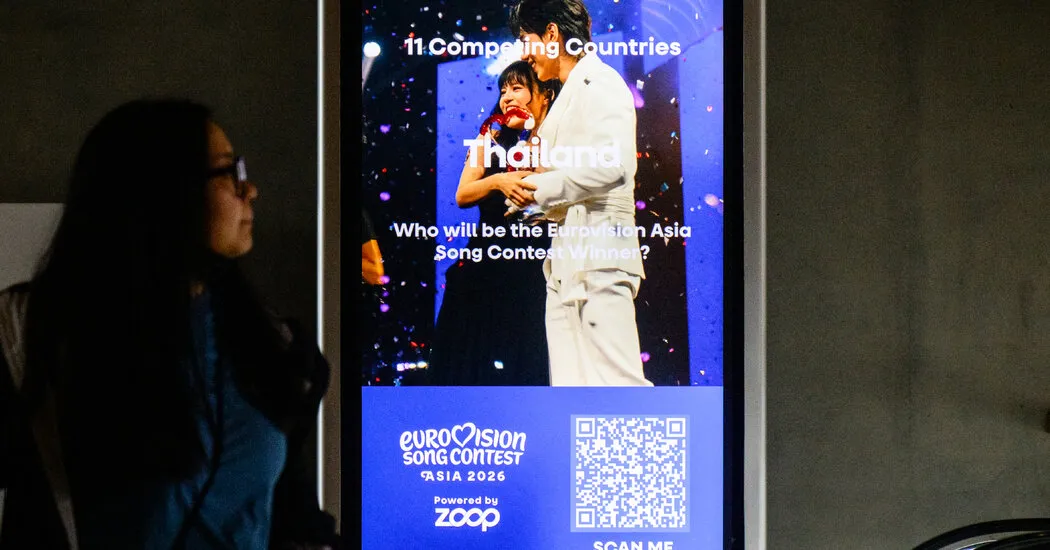
The Eurovision Song Contest, Europe’s long-running singing competition, will expand into Asia for the first time on Saturday, with singers from 11 countries vying for the title.
This is the third attempt by the European Broadcasting Union to develop an Asian spinoff of the high-camp competition. With Bangkok as host city, it will test demand in Asia for an international competition based on original songs.
The Eurovision Song Contest Asia could either be Eurovision’s first successful foray into another region — or a one-off flop like NBC’s American Song Contest.
The Asian edition will have a far smaller pool of competitors than its European counterpart, which typically includes over 30 countries. But it will include South Korea and Thailand, whose pop songs have found international audiences.
The contest will be live-streamed on YouTube on Saturday night local time (Saturday morning Eastern) and broadcast by government-owned and commercial television stations in the 11 participating countries. New York Times reporters in Bangkok and beyond will cover it live.
As in Europe, the winner will be determined by votes from a panel of judges and viewers from around the world.
Here’s what to know.
Why is Eurovision coming to Asia?
Eurovision, which began in 1956 as an experiment in synchronized programming by public broadcasters across Europe, has grown into a weeklong spectacle with an international fan base. The competition’s 70th edition in May was won by Dara, a singer who represented Bulgaria, with the dance-pop hit “Bangaranga.”
Organizers have unsuccessfully tried to replicate the contest outside Europe. The American Song Contest, which pitted singers from 56 states and territories, ran for only one season in 2022. An Australian public broadcaster, SBS, called off its yearslong attempt to bring Eurovision to Asia in 2021.
This time, the Asian project got off the ground partly because pop music from countries like South Korea, Japan and Thailand has global appeal, said Assaf Blecher, the executive producer of the Eurovision Song Contest Asia.
“It’s the right time for something to happen, with the evolution of music from Asia and the curiosity of Eurovision fans to see what’s happening beyond Europe,” he said.
Which countries will participate?
The 11 countries, in order of performance, are Vietnam, Cambodia, Laos, Mongolia, Bhutan, the Philippines, Bangladesh, Thailand, South Korea, Nepal and Malaysia.
Asia’s three largest media markets are conspicuously missing. Mr. Blecher said that broadcasters from China, India and Japan had been in talks to join the competition, but did not sign on in time to meet the deadline for entries.
To stage the competition in Asia, Eurovision had to overcome a fraught relationship with the continent’s broadcasters. In 2018, the European Broadcasting Union canceled a contract with China’s Mango TV, a provincial-government-owned streaming platform, after it censored elements of that year’s Eurovision show, including a gay love story depicted in an Irish singer’s performance.
Last year, China, India and Vietnam sent singers to Intervision, a Cold War-era song contest that Russia revived after it was expelled from Eurovision in 2022 over its invasion of Ukraine. A Vietnamese singer, Duc Phuc, won the contest with a song inspired by a mythical folk hero.
Who are the contestants?
Each country will send a singer who won a national contest with an original song. For emerging singer-songwriters like Nepal’s Pratik Himal Rai and Bhutan’s Nyendra, winning their national contests was life-changing.
Others, like Malaysia’s Aina Abdul and Vietnam’s Toc Tien, are established pop stars with decades-long careers. Bangladesh’s entry, Beatmosphere, is a six-member a cappella group that formed in 2009.
The 11 acts will perform a wide range of genres: love ballads, a hip-hop track, a rock song and dance anthems. Some artists, like Thinla of Laos and Junhee of South Korea, will sing in English.
How will the competition work?
Each act will have three minutes to perform onstage at the One Bangkok Forum, a newly opened auditorium in central Bangkok that can seat around 5,000 people.
Once a performance is complete, a jury in each country will rank the songs. Those rankings will be converted into point scores for each singer, from zero to 12.
Public voting — in each country and among YouTube viewers watching internationally — will also be used to allocate points. The public and jury scores will then be combined to work out the winner.
Viewers from participating countries cannot vote for their own nation’s act.
A QR code will be shown onscreen to direct viewers to the Eurovision Asia voting website. Each user will have eight votes for free to distribute to at least three songs. They can purchase up to 10 extra votes.
The organizers said that they expect most viewers to watch the show from their phones and personal devices, not on television. Last year, the European contest’s final competition received more than five million views on YouTube.
The winner of the Asian contest will be invited to perform at the European edition next year, though not as a competitor. And unlike in Europe, the winning country will not automatically be chosen to host next year.
Alex Marshall contributed reporting from London.