

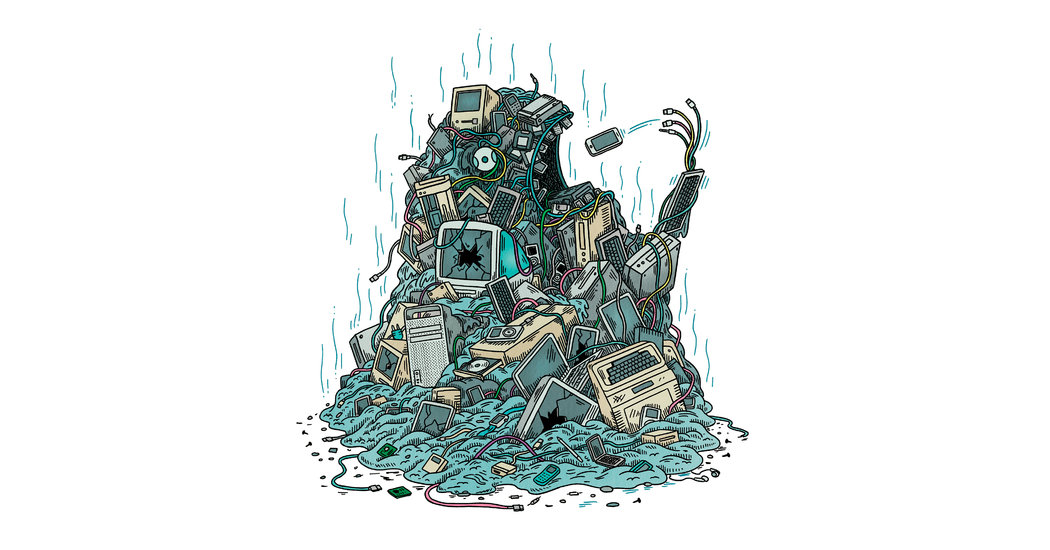
The idea of “mining” e-waste has tantalized the recycling and electronics industries for decades. Until recently, most methods to extract value have been costly, inefficient and hazardous. Backyard recyclers in places like India and Indonesia recover gold by bathing circuit boards in nitric and hydrochloric acid, thus poisoning waterways and communities. Others, like the migrant workers in Thailand, break down used electronics with cooking stoves and shredders and wear no protection against the emissions.
Over the last few years, however, innovators have devised safer techniques in the lab that would wrest value from e-waste. One isolates rare-earth elements with carbon nanotube technology; another recovers key minerals by bombarding them with underwater sound waves. Josh Lepawsky, a Canadian geographer and the author of “Reassembling Rubbish,” finds hope in a curious phenomenon: the growing re-export of e-waste from the developing world back to advanced countries that have greater recycling capacity. An “e-waste offset” by which countries importing high-quality used electronics send back an equal volume of e-waste “is very promising,” Lepawsky says.
As the extraction of metals becomes more efficient and eco-friendly, tech manufacturers may feel compelled to get raw materials from their own end-of-life products rather than from the earth. Apple, for instance, has pledged to make all of its future laptops and iPhones out of renewable resources or recycled materials. The idea goes beyond business to national security. “Governments are starting to take a more strategic view of e-waste, too,” Khetriwal says. “They ask, ‘How can we secure the raw materials we need for the future?’ ” Some of these metals and rare-earth elements are scarce, and some, like cobalt, are found mostly in conflict zones. By mining the ever-expanding mountains of e-waste, countries could steel themselves against the volatility in prices and supplies of the global market.
Some e-waste optimists envision a “circular economy” in which refurbished, reused and recycled raw materials help fuel a sustainable future. Japan was an early leader of this movement, pushing e-waste recycling with tough laws and, more recently, appealing gimmicks. At the 2020 Olympic Games in Tokyo, athletes will receive gold, silver and bronze medals forged from recycled e-waste — emblems of a world in which e-waste can take on the sheen of immortality.
The utopian vision of a circular economy is a long way off, though. E-waste recycling remains stubbornly low in most parts of the world. Even the extraction of precious metals has proved hard for companies to capitalize on. And the remaining mass of e-waste — mainly plastics laced with metals, chemicals and flame retardant — pose a more intractable problem. The recycling of these complex plastics would probably need to be subsidized or enforced through legislation — and few countries outside Europe or Japan have shown the commitment to make that happen.
To move toward a circular economy, manufacturers would also need to embrace a “green design” that minimizes the generation of e-waste in the first place. Companies like Apple and Dell, though, have not taken enough measures to make their products easier to use longer. “Planned obsolescence,” the intentional creation of products that rapidly become outdated so customers must replace them with ever-newer models, remains the modus operandi of the tech industry. Manufacturers argue that the approach stimulates not only profits but also the very innovation that drives the global economy. And it has produced a Pavlovian response in consumers, for whom the temptation to buy a slightly cooler phone every couple of years has hardened into a seeming necessity. Not long ago, one tech manufacturer introduced a cheaper, longer-lasting phone — the perfect antidote to planned obsolescence. It was not a hit — but it was a reminder that we all share some responsibility for the explosion of e-waste in scrap yards across the world.