

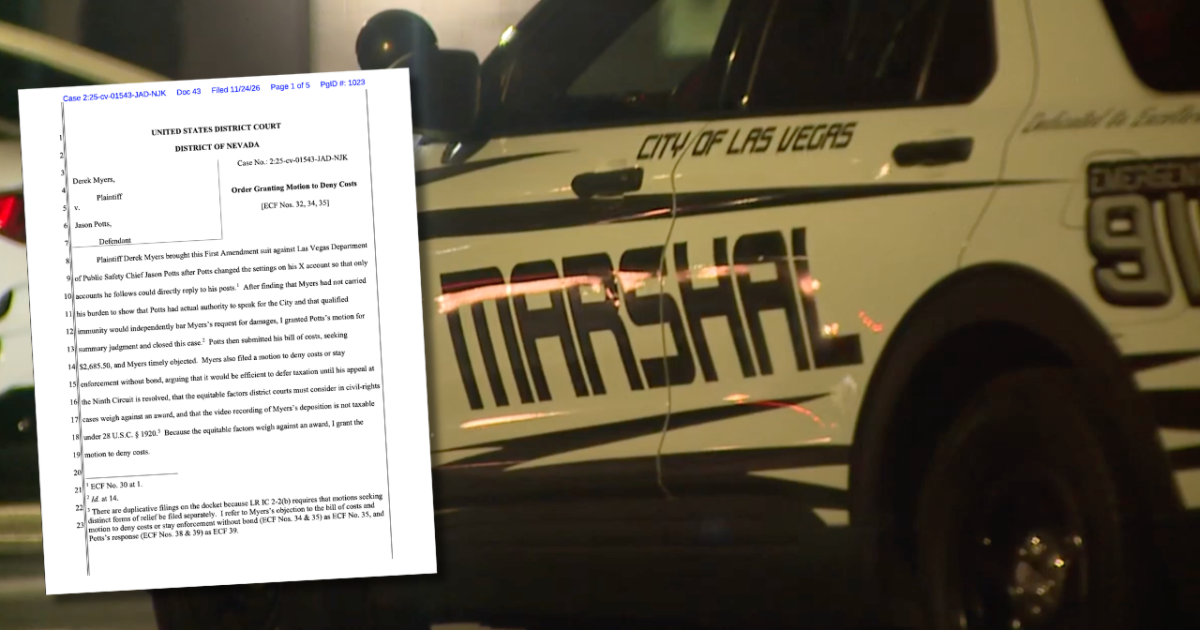
An Ohio journalist who lost a First Amendment lawsuit against the head of the Las Vegas City Marshals won’t have to pay nearly $2,700 in costs the official wanted him to cover.
U.S. District Judge Jennifer Dorsey ruled Tuesday that Derek Myers should not have to pay the $2,685.50 sought by Las Vegas Department of Public Safety Chief Jason Potts.
The amount isn’t huge. But the reason the judge refused to make him pay could matter to anyone considering taking a government official to court.
Dorsey said making someone pay the government’s costs after losing a civil rights case could discourage other people from going to court when they believe the government has violated their constitutional rights.
The ruling is the latest turn in a legal fight that grew out of a controversial Las Vegas City Marshals traffic stop that 13 Investigates has been following since March 2025.
Myers lost his lawsuit, but the judge says he shouldn’t have to pay
Myers sued Potts in August 2025 after the public safety chief changed the settings on his X account so only accounts he followed could directly reply to his posts. Myers argued that unfairly silenced critics and violated the First Amendment.
Dorsey ultimately sided with Potts.
She found that Myers had not shown that Potts had the legal authority to speak on behalf of the city of Las Vegas through his X account. She also found Potts was protected from being held personally liable for damages.
Myers is appealing that ruling to the Ninth Circuit.
After winning the case, Potts asked Myers to pay $2,685.50 in costs from the lawsuit. Winning parties are generally allowed to recover certain court costs, but judges can refuse to award them.
That’s what Dorsey did here.
Why the judge says this case matters
Would making people pay discourage them from challenging government?That was a key part of Dorsey’s decision. Myers didn’t prove that he couldn’t afford the $2,685.50 bill. But the judge pointed to what she called an”obvious economic disparity” between one individual and a government official whose legal defense is paid for by the city. She also worried about the message a bill like this could send to other people: Challenge the government over your constitutional rights, lose, and you could end up owing thousands of dollars toward the government’s costs. Dorsey said that could have a”chilling effect” on others considering civil rights lawsuits. Judge rejects argument that Myers acted in bad faithPotts’ attorneys also argued that Myers was motivated by anger and a desire to pile legal pressure on the city. They pointed to an X post in which Myers declared that “Derek Myers does not lose” and predicted that “the bloodbath is only beginning.” Dorsey wasn’t persuaded. She found that Myers could be angry with Potts while also legitimately challenging what he believed was unconstitutional viewpoint discrimination. This fight started with a traffic stopThe dispute between Myers and Las Vegas officials didn’t start on social media. It started on Jan. 9, 2025, when Las Vegas City Marshals pulled Myers over on U.S. 95 near the Craig Road off-ramp while he was in Las Vegas for the Consumer Electronics Show. Marshals reported Myers followed them too closely, drove on the shoulder and reached 80 mph. They put him through field sobriety tests, arrested him and booked him into the city jail, where he was held for 17 hours. Myers recorded the encounter on his own body camera and later brought that footage to 13 Investigates.
A little more than two months later, attorney Adam Breeden filed a federal class-action lawsuit on behalf of Myers and potentially thousands of others.
At the heart of that lawsuit is another basic question: Where do Las Vegas City Marshals actually have the authority to enforce the law?
The lawsuit argues Nevada law limits their jurisdiction to the Fremont Street Experience and property the city owns, leases or controls, such as parks and city buildings. Myers was stopped on a state highway.
The city has disputed that interpretation and argued that its marshals had legal authority to stop Myers and probable cause to arrest him.
Criminal charges came five months after the stop
Myers was not criminally charged when he filed that lawsuit.
The charges came later.
On June 9, 2025, five months after the traffic stop and more than two months after he sued, city prosecutors charged Myers with misdemeanor reckless driving, failing to provide proof of insurance for his rental car and misdemeanor DUI involving a prescription drug.
Breeden called the charges retaliation for the lawsuit. City officials disagreed, saying the case involved a disregard for public safety and pointing to what they described as signs of impairment during the field sobriety tests.
The DUI allegation did not involve alcohol.
The city’s toxicology report found no alcohol, marijuana or hard drugs. It did find 18 nanograms of clonazepam, an anti-anxiety medication Myers told marshals at the scene he had taken. His then-criminal defense attorney, Chip Siegel, previously told 13 Investigates that amount most likely had no effect on his driving.
That case will likely be set for trial in February.