
Buddhism, born on the Indian subcontinent in the sixth century B.C., has no holy book, no commandments, no prophets. Yet its teachings spread throughout Asia, mingling with local beliefs and customs along the way — and changing the continent forever.
In the three-part cover story for T’s Travel issue, Aatish Taseer follows Buddhism’s journey through Nepal, Thailand and Taiwan.
Plus: we share a map and timeline of the religion’s transmission across the East, a glossary of Buddhist terms, a snapshot of the great diversity of Buddhist monuments and an essential reading list. Click here to read Hanya Yanagihara’s editor’s letter.
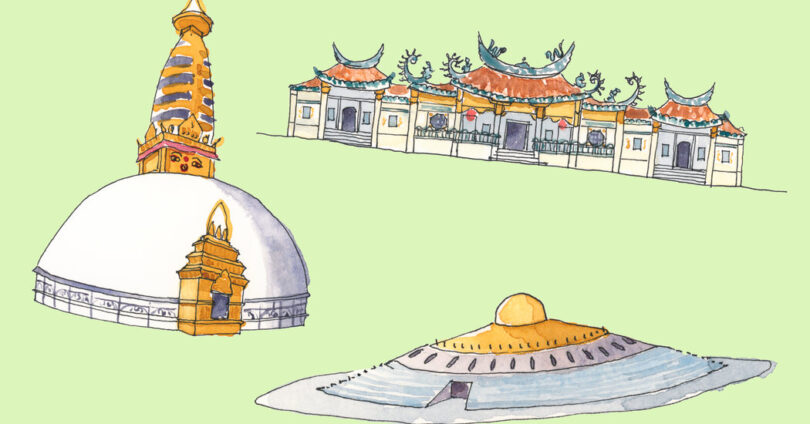
The adaptability of Buddhism is the secret to its survival, and this is as true in architecture as it is in practice. The quintessential Buddhist monument, dating to third-century B.C. India under the rule of Emperor Ashoka, is the stupa, a dome-shaped structure, or reliquary mound. In addition, the Buddhists built pagodas, monasteries, chaityas (or prayer halls) and rock-cut caves. These religious buildings constituted some of India’s earliest architecture in stone, and the transmission of these structures, as Buddhism spread east, was part of the magic of the continuity and change that were integral to the appeal of the new teaching. Everywhere Buddhism went, certain buildings such as the temple or the stupa were remade in the image of the culture they came into contact with. Local artisans and builders leaped at the challenge of assimilating these structures, which often led to a flowering of creativity, even as the monuments together are a testament to the tremendous elasticity of Buddhism.
Swayambhunath Stupa
Nepal’s fifth-century Swayambhunath Stupa, with its 13-parasol gold finial and its harmika, or squarish base, on which beguiling Tantric eyes have been painted, is central to the founding myth of the Kathmandu Valley, which it overlooks on all sides. It’s also one of the great sites of syncretic worship, where Hindus and Buddhists alike come to pray, and where Himalayan Buddhism, from Tibet to Bhutan, is represented in all its esotericism.
Great Memorial Hall of Phramongkolthepmuni
North of Bangkok, Wat Phra Dhammakaya’s Great Memorial Hall of Phramongkolthepmuni, built in 2002, is sometimes described as “the nipple,” other times as a U.F.O. This futuristic symbol of charismatic Buddhism in Thailand may have its critics, but one can’t argue with its success. The appeal of this Instagram-ready Buddhism is colossal. It’s all smooth lines, matte metal surfaces and prisms, and it speaks to what a booming new middle class wants its dharma to be.
Lungshan Temple
Originally erected in 1738 in Taipei, Taiwan, and restored several times over the years, Lungshan Temple is a joyful confection of traditional Hokkien-style architecture with sweeping tiled roofs, flying eaves and heavily carved stone pillars. Its square-within-a-square design and open courtyards create an air of conviviality, even as dragons lurk and subsidiary shrines enclose local deities, including one devoted to matters of the heart.


.jpg?w=145&resize=145,100&ssl=1 "10 มหาเศรษฐีอายุน้อยที่สุดในโลกปี 2026 ใครรับมรดกตระกูลดัง ใครสร้างธุรกิจเอง?")
